 Traveler
Series Inc.
Traveler
Series Inc.Hotel of the Month:
Courtyard Mt. Pleasant

1251 Woodland Ave
Mount Pleasant, SC 29464
Contact: Front Desk
Tel - 843-284-0900
Fax - 843-284-4949
-
100% Smoke Free Hotel
-
Outdoor Pool
-
Free WiFi
Interested in travel?
Check out our travel sites:




Contact Us
Traveler Series Inc.
3007 1/2 De La Vina
Santa Barbara, CA 93105
Tel # (805) 569-1750 or Fax (805) 687-4462
email: salestsi@travelerseries.com
World's longest tunnel takes 20 minutes to cross with trains
reaching 155mph
The high-speed rail tunnel extends as far down the mountains as some of the deepest mines on the planet.
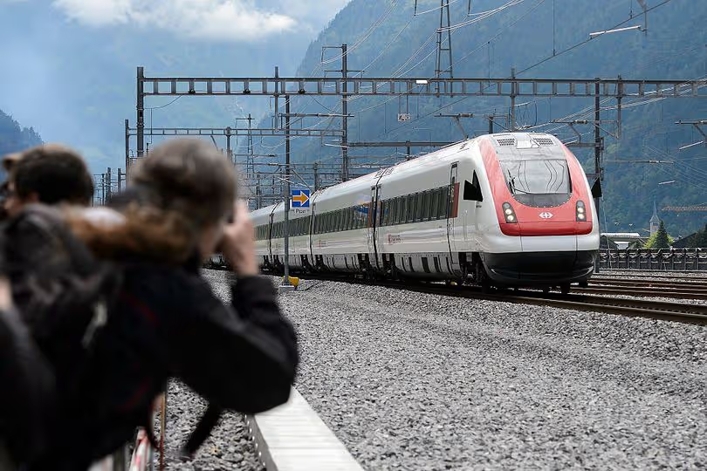
Nothing stands in the way quite like Europe's highest and most
extensive mountain range.
With France on one end and Austria the other,
the Alps sprawl 1,200km across eight countries in a massive crescent
shape.
Historically, Alpine crossings were perilous journeys taken on foot or
mule. For as long as people have been in Europe, they have sought to
cross this mountain range so vital for travel, trade and war.
The Romans fought battles to control routes through the Alps. Historic
figures, including Hannibal — with elephants in tow — then later
Napoleon, led armies over the mountains to gain a strategic wartime
advantage.
They'd have wished for something like the Gotthard Base Tunnel, a
corridor between northern and southern Europe that opened in 2016. At
the cost of about £11.5bn, it is the longest and deepest tunnel ever
built.
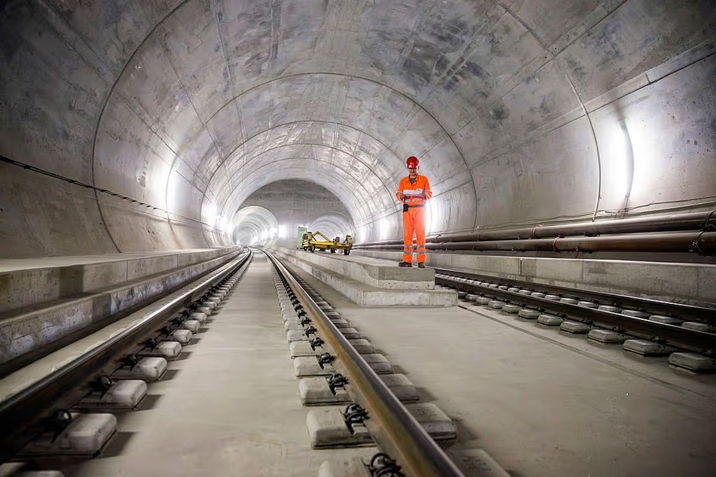
It's a crucial link for travel as well as the transport of
goods across Europe. Used by freight and passenger trains, it cuts
travel time from Basel to Zurich and Milan to Lugano by up to an hour.
The Gotthard tunnel extends 57km — a 20 minute journey underneath the
majestic Alps that loom above. Remarkably, its depth of 2.3km is
comparable to some of the deepest mines in the planet.
Trains are able to zip through at a maximum speed of 155mph due to
their clever design.
Where older tunnels spiral their way up the mountains, the Gotthard is
completely flat. It's the first flat route through the Alps or any
other mountain range.
As the world's longest tunnel, it bypasses the Channel Tunnel running
between England and France by 7km.
It beat out the previous world record holder, Japan's Seikan rail
tunnel, by 3km. The Seikan tunnel connects the country's two largest
islands, Honshu and Hokkaido.
The tunnel was created to replace the first Gotthardbahn rail tunnel,
an engineering marvel of its time that was completed in 1882.
Plans for its replacement began a century later in the 1980s. It was an
ambitious and arduous project that took 17 years to build.
With 35 miles of mountain pressing down on the route, one of the
critical challenges was how to prevent the tunnel from collapsing in on
itself. Fortunately, reinforced steel rings spanning the tunnel support
the weight of the mountain above.
The project required the use of a massive drill the length of four
football fields. At 410m long and 10m wide, it carved through 40m of
mountain a day.
The Daily Star UK